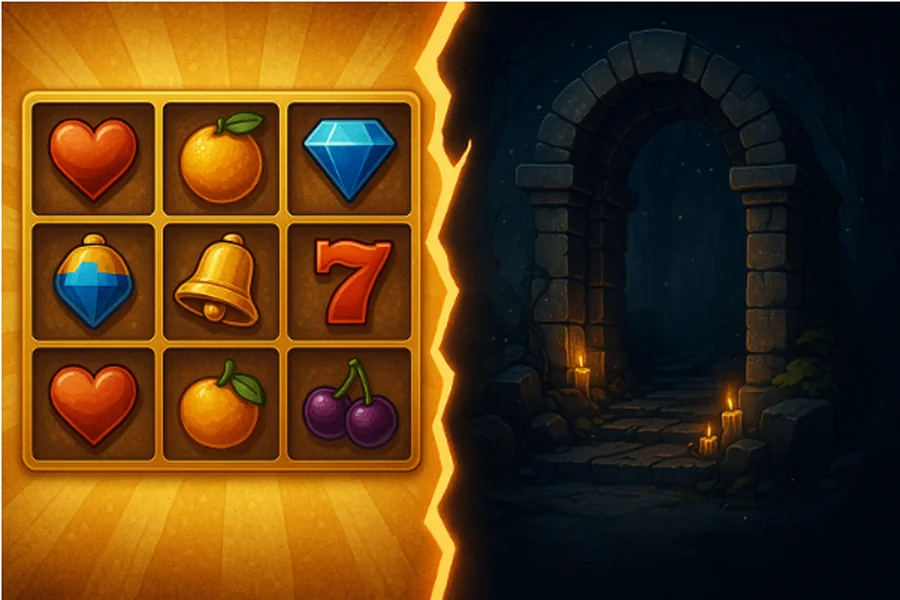
There’s a fine line between boredom and chaos, and game designers spend countless hours walking it. Why do some games feel flat after 10 minutes, while others keep players hooked for years? What’s the secret behind that elusive feeling of “just right” — the sensation that you’re always engaged, challenged, and rewarded in perfect proportion?
It turns out the magic lies somewhere between predictability and mystery.
Let’s unpack this tension. Let’s feel it. Whether it’s a high-stakes strategy game, an indie narrative gem, or even a slot online experience, the interplay between knowing what comes next and being constantly surprised is what makes a game not just playable — but irresistible.
Patterns are comforting — to a point
Humans love patterns. From infancy, we learn by observing cause and effect: press a button, something happens. Pull a lever, get a result. The brain thrives on predictability. In gaming, that’s a feature, not a flaw.
Predictability builds confidence. It tells the player: “You’re getting better.” It allows for strategy, mastery, and control. A jump feels right when the timing’s consistent. A combo becomes satisfying when muscle memory kicks in. Predictable mechanics are the backbone of skill-based gameplay.
This is true across genres. Whether you’re chaining attacks in a fighting game, memorizing track layouts in a racer, or anticipating enemy movement in a stealth mission — the joy comes from gradually cracking the code. Learning the system is its own reward.
But predictability, when left unchecked, becomes monotony. The player starts to drift. The stakes evaporate. Every win feels inevitable.
That’s where mystery steps in.
Uncertainty adds spark
Uncertainty is risk. It’s a possibility. It keeps you leaning forward.
When a game introduces the unexpected — be it a hidden enemy, a random reward, or a sudden change in the rules — it lights up a different part of the brain. Now, you’re not just applying known strategies; you’re adapting, improvising, reacting.
This is where Slot Online games have perfected the formula. While their core gameplay is simple, the appeal often lies in the controlled randomness. You think you know what might happen, but you’re never quite sure. The suspense between a near-miss and a jackpot is engineered to trigger a cocktail of anticipation, tension, and hope.
It’s a concept many genres borrow from. Consider roguelikes, where every playthrough reshuffles the deck. Or multiplayer shooters, where opponents are unpredictable. Or narrative adventures, where a dialogue choice might snowball into unintended consequences.
Mystery fuels exploration, raises questions, and keeps attention sharp. But — and this is important — too much of it, too soon, and the player feels lost.
Finding the sweet spot
So what makes a game feel “just right”?
It’s a balance.
The best games allow the player to predict just enough to feel in control — but always with a layer of mystery lurking beneath. Every action has a likely outcome, but not a guaranteed one. Every level offers familiar tools, but new combinations. Every win is deserved — but not always expected.
Slot88, for instance, thrives in this balance. Its interface is clear and consistent. The core interaction doesn’t change. Yet within that structure lies a universe of variability — from rare symbol combinations to unexpected multipliers. Players aren’t confused, but they’re never completely at ease either. That tension, that push and pull, is precisely what keeps them coming back.
This balance also shows up in massive AAA titles and small indie hits alike. In a game like The Legend of Zelda: Breath of the Wild, the physics system is predictable — but how you apply it to solve problems is wide open. In Hades, you start every run knowing the basics, but the weapon upgrades, enemy placements, and story beats evolve with each attempt.
Good games teach you the rules — then let you play with them.
Structure breeds freedom
Here’s a paradox: unpredictability is only enjoyable because it happens within a structure.
Think of it like jazz. The genre is built on improvisation, but it’s grounded in rhythm, key, and form. Without that structure, the music would be noise. Games follow a similar principle.
When a player understands the rules, they can appreciate the surprises. A wild twist has no impact if it comes out of nowhere in a system the player doesn’t understand. But if the player knows the rules — and sees them being bent or twisted — that surprise hits deeper.
This is why random events in games work best when they follow some logic. If an enemy ambushes you in a location you assumed was safe, that’s scary — but if that same ambush happens every 30 seconds regardless of context, it becomes frustrating. Predictable unpredictability is the secret ingredient.
Games like Dead by Daylight thrive on this dynamic. Each match follows a set pattern — survivors power up generators, the killer hunts them — but the unpredictable human element and procedural maps ensure that no two games ever play the same. Structure enables chaos, not the other way around.
The role of feedback
One often overlooked element in this balance is feedback — how the game communicates with the player.
Clear feedback turns chaos into discovery. If a player tries something unexpected and the game responds in a satisfying way — even if the result isn’t ideal — the player feels smart. They feel seen. Encouraged.
Games that blend predictability and mystery well often have responsive sound design, animations, and UI cues. That spin of the Slot Online reel, with its escalating pitch and flashing lights? It’s not just flair — it’s information. It tells the player that something exciting might happen. It ramps up tension. It makes every result feel meaningful.
This kind of feedback also helps players learn. Even when something unexpected happens, good feedback lets players make sense of it. This transforms mystery from confusion into intrigue.
Challenge and progression
Another crucial factor in feeling “just right” is challenge — and how it changes over time.
Early in a game, predictability is king. Players need time to understand controls, systems, and objectives. But once that foundation is laid, the game must evolve. It must surprise. It must raise the stakes.
This doesn’t mean games should become chaotic. Instead, the predictability should shift to higher levels. Players should begin to anticipate not just what’s happening now, but what could happen next.
The best games gradually move the player from reacting to planning, from uncertainty to strategy — while never removing that tiny thread of doubt. That’s the magic space: confidence tinged with suspense.
Emotional timing
Beyond mechanics, there’s the emotional rhythm of a game.
Predictable moments offer calm, mastery, and satisfaction. Mysterious moments spark excitement, wonder, even fear. A well-paced game understands how to alternate these emotional beats — and when to blend them.
A slow, moody level can lull players into a sense of safety, then jolt them with an unexpected threat. A victory that feels easy might suddenly become bittersweet with a surprise twist. An anticipated reward might come with an unforeseen cost.
This emotional modulation is storytelling at its best. And whether it’s told through cutscenes, combat, puzzles, or the spin of a Slot Online wheel, it taps into the same core truth: people remember how a game makes them feel.
Why do we keep playing
We chase games that understand us.
We return to the ones that respect our intelligence, reward our curiosity, and surprise us just enough to keep the fire lit. Too much predictability, and the fire dims. Too much mystery, and it burns out fast.
The middle path — where games are structured yet wild, learnable yet surprising — is where the magic lives.
Slot88 knows this. So does Elden Ring. So does Wordle, Tetris, and a thousand others. Whether casual or complex, short or sprawling, these games share one quality: they make us feel like we’re learning something new just as we were getting comfortable.
That’s what makes a game feel just right. Not because it’s perfectly balanced, but because it’s always moving — just slightly — out of reach.
