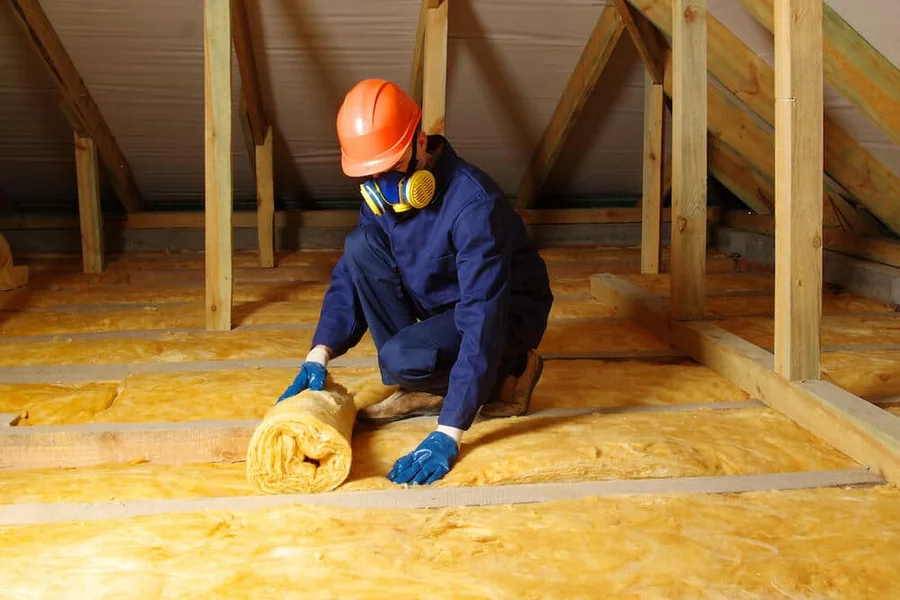
Attic insulation plays an important role in keeping indoor temperatures comfortable and reducing heating and cooling costs. However, the R-value listed on insulation packaging doesn’t always reflect how effectively the material performs once installed. Gaps in coverage, compression, settling, and air leaks can all reduce its effectiveness over time.
If certain rooms feel warmer in summer or colder in winter, your attic insulation may be contributing to the problem. Understanding what affects insulation performance can help you identify potential issues and determine whether your attic needs additional insulation, better air sealing, or more extensive improvements.
What Does R-Value Measure?
R-value measures resistance to heat flow through a material at a specific thickness, tested in a lab under controlled conditions. The test assumes the material is sitting flat, at its full depth, with no air moving through it and no thermal bridges nearby. That’s almost never how attic insulation lives in a real house.
A contractor guide from the Department of Energy walks through this plainly: installed R-value depends on material type, thickness, density, and how carefully the job was done. Compress a batt by a third and you don’t get two-thirds of the rated R. You get less. A quarter-inch void along a joist is all the heat needs to route around the batt.
Why Is My Attic Running Below Its Rating?
A handful of ordinary things pull the installed number down year after year, and most of them are invisible from the hallway. For a professional look at the attic itself (depth, coverage, air sealing, and whether what’s up there is worth keeping) attic insulation services can give you a straight assessment before you commit to a full replacement.
- Settling. Loose-fill materials pack down under their own weight and from humidity cycling. Cellulose settles the most; fiberglass and rock wool settle less but still move. What was installed at R-38 depth may measure several inches shallower a decade later.
- Compression. Storage boxes, catwalks, HVAC techs crawling to the air handler. Any weight on a batt crushes the air pockets that do the actual insulating, and a compressed batt is a lower R-value for good.
- Air movement. Insulation slows conductive heat transfer. It does very little against air leaking through top plates, recessed lights, bath fan housings, and the attic hatch. Air carrying heat right past the insulation makes the rating irrelevant for those pathways.
- Thermal bridging. Framing members conduct heat around the insulation. A standard attic has joists every 16 or 24 inches, and each one is a small highway for heat the batts can’t block.
- Coverage shortfalls. Corners, eaves, and the perimeter where the roof meets the top plate are easy to under-fill. The thermometer averages the whole ceiling, so a thin strip at the edge drags the whole room down.
How Do I Know What My Attic Is Doing?
You can get a surprisingly honest read with a tape measure and a flashlight. Pull down the attic hatch, measure the depth of the insulation in several spots away from the edges, and compare it to the depth that material needs to hit its rated R-value. Blown fiberglass at R-38 wants roughly 13 to 14 inches; cellulose wants closer to 10 or 11. If you’re looking at 7 inches of fluff that used to be 11, you have your answer.
Look for the other tells too: dark streaks on the insulation (air moving through dust), visible top plates, daylight around the hatch, a bath fan duct dumping into the attic instead of out the roof. A whole-house energy audit with a blower door will put real numbers on the air leakage, and a thermal camera on a cold morning will show the cold spots on the ceiling below.
Seal the Leaks Before You Add Depth
Blowing more insulation on top of a leaky ceiling is a common and expensive mistake. The air leaks are still there, just hidden under a thicker blanket, and now you can’t find them. Seal the penetrations first (top plates, wire holes, plumbing stacks, recessed can lights rated for contact, and the attic hatch) and the added R-value will finally show up on your bill.
The payoff is real. Done in the other order (insulation first, air sealing never), you’re paying for R-value the air is routing around.
Sometimes You Need to Start Over
Topping off is cheap and often enough. Starting over is sometimes the right call. If the existing material is contaminated with rodent activity, soaked from an old roof leak, matted into a crust, or so compressed around the HVAC equipment that it’s doing nothing, adding more on top is throwing money at a bad foundation.
A full removal lets the installer air-seal the deck properly, correct any bath fan or soffit vent problems, and install the new insulation at the depth it needs to actually hit the number on the plan. That’s the version where R-49 means R-49, instead of R-49 on paper and R-28 in the house.
