The U.S. Geological Survey classifies any water above 180 mg/L of dissolved calcium and magnesium as very hard, and a huge share of American households sit above that line without realizing it.
That number matters because the tank in your utility closet reacts to it a little at a time. Most owners never look at the unit until something goes wrong, and by then the damage has been building for years.
A water heater rarely dies from one event. It ages in stages, and each stage has its own villain: sediment settling to the bottom, an anode rod dissolving out of sight, and water chemistry doing slow work on the steel. Knowing the sequence is the difference between replacing a tank at year eight and getting fifteen good years out of it.
Day One: The Water You Have Decides the Fight
Before the installer pulls out of the driveway, your local water chemistry has already set the terms. Hard water carries dissolved calcium and magnesium that precipitate as scale when heated. Soft or softened water is gentler on scale but harsher on the metal parts inside the tank, because a higher sodium content makes the water more electrically conductive.
Neither condition is a defect. Both simply push the tank to age in a particular direction. A homeowner who knows their water is very hard should plan on aggressive flushing. A homeowner on a softener should plan for faster anode wear.
If you’re not sure which camp you’re in, a licensed plumber can pull a quick water sample and tell you before the first year is up.
Years One Through Three: Sediment Starts Settling
Every time the burner or element fires, tiny mineral particles drop out of solution and land at the bottom of the tank. In a gas unit, that layer sits right between the flame and the water it’s supposed to heat. In an electric unit, it buries the lower element.
The consequences show up early, even if you don’t notice them. A yearly flush is the simplest fix. The Energy Trust of Oregon’s maintenance guide walks through the drain-and-flush procedure in plain terms, and most owners can handle the job with a garden hose and an hour of patience.
Years Four Through Eight: The Anode Rod Is Doing the Dying
Inside the top of every tank sits a sacrificial anode rod, usually magnesium or aluminum wrapped around a steel core. It exists to corrode in place of the tank. While it’s healthy, the tank is safe. When it’s gone, the tank is next in line.
Nobody sees this happening. The rod is threaded into the tank head, out of view, and in aggressive water it can be almost fully consumed by year five. Pull it, look at it, and replace it if the steel core is exposed for more than a few inches. Softened-water households should check earlier and more often, because the same conductivity that makes softened water pleasant to shower in also speeds up galvanic wear on the rod.
Year Ten and Beyond: What You’re Actually Paying For
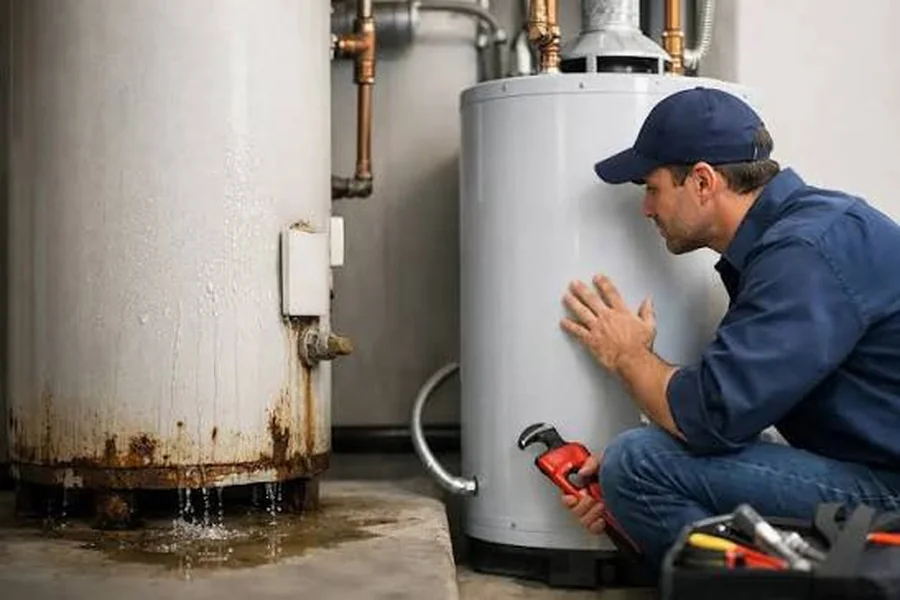
A tank that’s been flushed on schedule and had its anode swapped once or twice can outlive its warranty by a wide margin. A tank that’s had neither is likely rusting from the inside by year eight, whether or not it’s leaking yet.
The maintenance isn’t glamorous, and it does cost you time. But replacing a rod costs a fraction of replacing a tank, and flushing costs almost nothing. The water heater you inherit at year ten is the one you decided to have at year one.
